Render a Sketch in Different Styles: Luma vs. Midjourney
You have a sketch — a character, a product concept, a storyboard frame — and you need to see it in five different visual styles before the client meeting. This page tests Luma and Midjourney head-to-head on exactly that workflow: sketch-to-styled-image, across multiple aesthetics, at production speed.
We ran the same pencil sketch through both tools across six style targets: photorealistic, oil painting, cel animation, architectural render, editorial illustration, and cinematic still. Here's what came back — and which tool you should reach for.
Final Score Luma: 8.4/10
Final Score Midjourney: 8.1/10
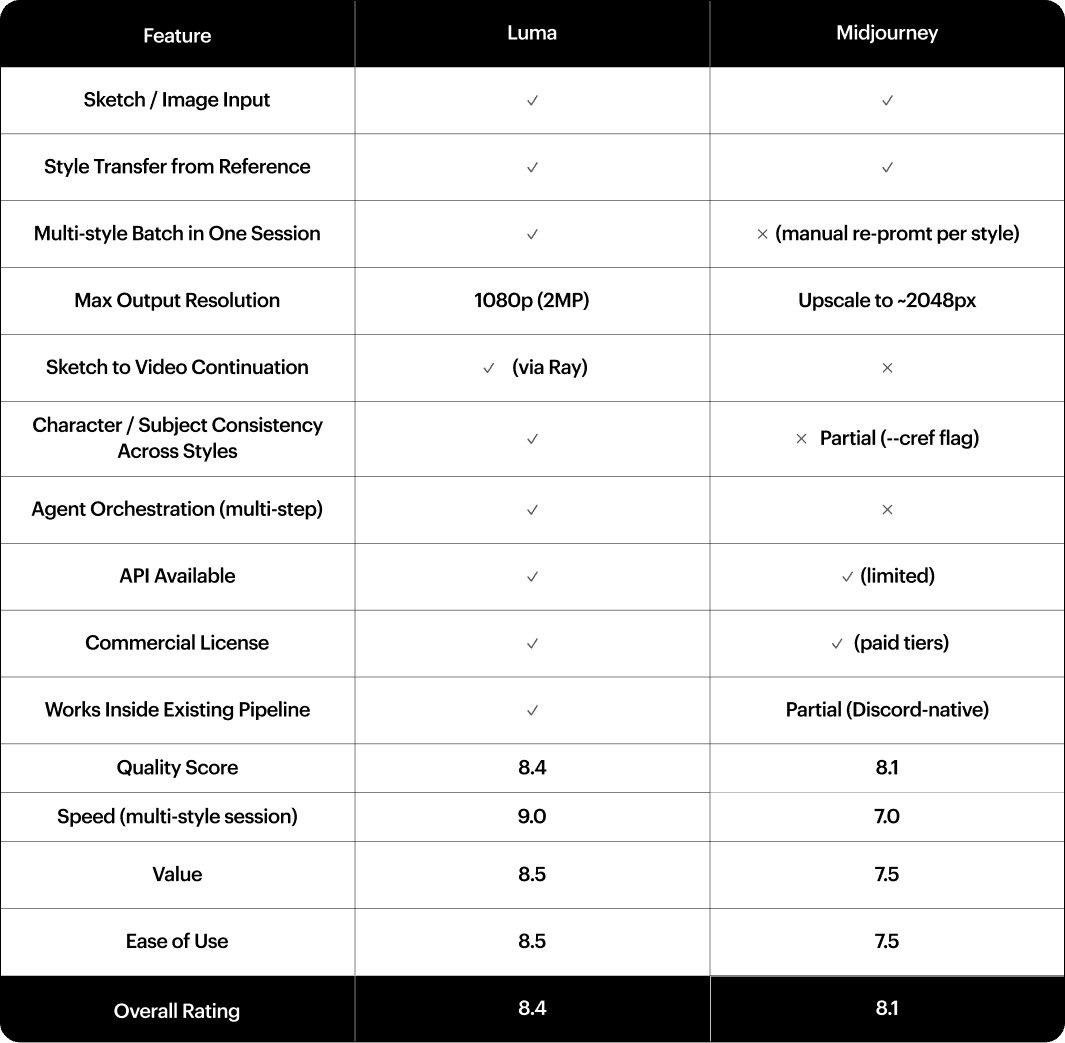
Overall Verdict
idjourney produces aesthetically distinctive results and has a community of style templates to draw from. Luma wins on workflow: you stay in one place, run style variants in parallel, and carry the same sketch into video without re-uploading or switching tools. For teams who need the finished board — not just the prettiest single frame — Luma is the faster path.
- Best for style range: Luma
- Best for single output: Midjourney
- Best for production workflow: Luma
- Best for value at volume: Luma
Key Differences
- Batch style variants: Luma runs multiple style prompts against the same sketch in one session. Midjourney requires a separate prompt and manual download for each style.
- Sketch → video path: Luma connects Photon (image) to Ray (video) in the same agent session. Midjourney has no native video output.
- API pricing: Luma Photon at $0.016/image vs. Midjourney's subscription-only model with no public per-image API rate.
- Subject consistency across styles: Luma maintains structural fidelity to the sketch across all style variants natively. Midjourney requires --cref flags and produces variable results.
- Platform context: Luma runs in a web-based agent interface built for production teams. Midjourney runs in Discord, which adds friction for professional pipeline integration.
Which Should You Choose?
For a single hero image where aesthetic distinctiveness is the only criterion, Midjourney is a legitimate choice. For a production workflow where you need 6 styles and a path to motion — Luma completes the job that Midjourney starts.
Midjourney's image quality on individual outputs is high. Its aesthetic model produces visually distinctive results — particularly for painterly, fantasy, and editorial styles — and its community has built an enormous library of style references and prompt formulas.
The gap shows up in workflow. Midjourney operates primarily through Discord, which means each style variant is a separate prompt in a separate message. There is no shared session context, no parallel batch, and no direct path from a rendered image to video. For a six-style sketch exploration, you are making six separate requests, downloading outputs individually, and switching to a different tool to animate any of them.