Design a Brand Identity: Luma vs. Runway
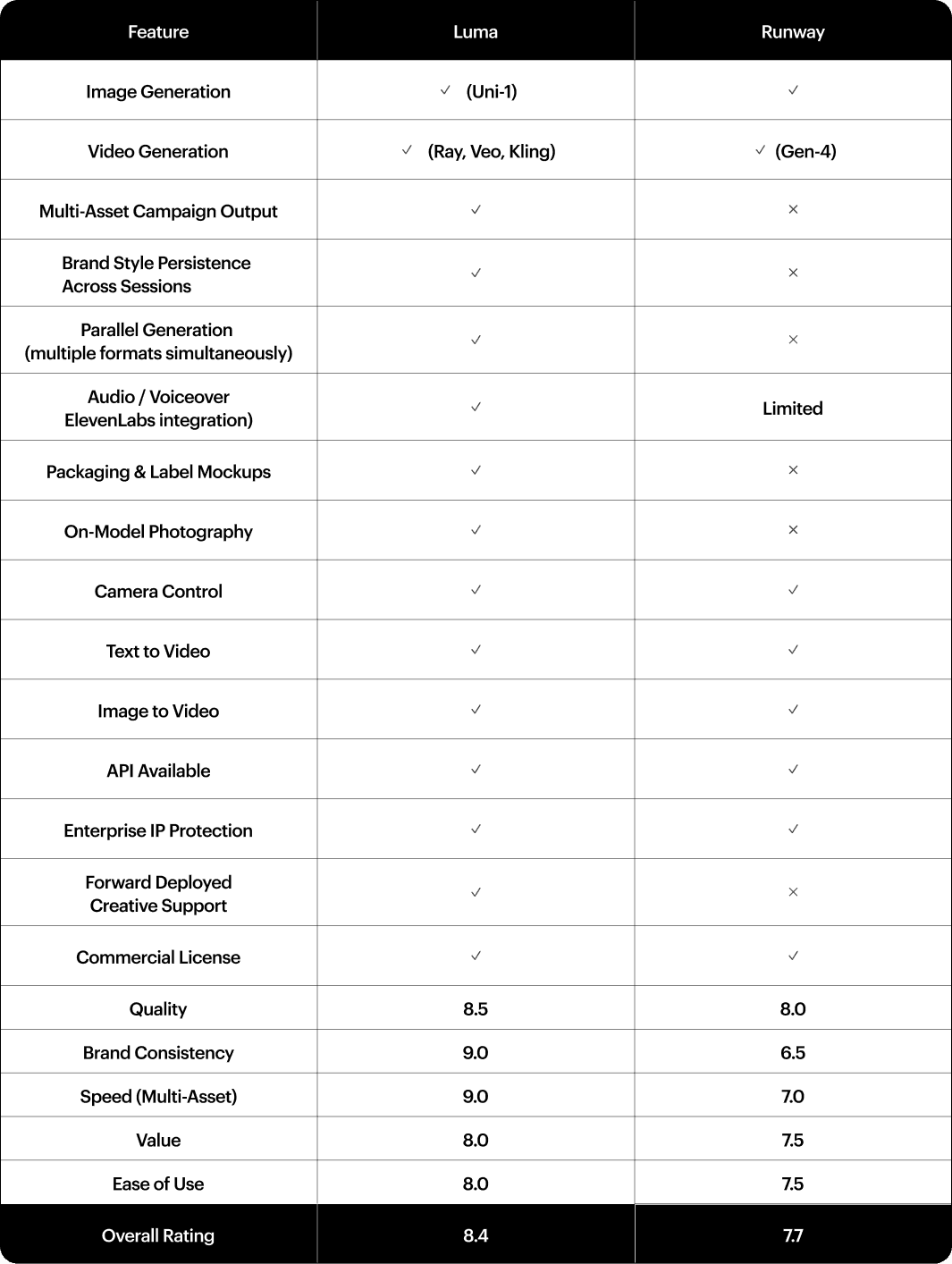
Luma and Runway are used extensively for brand identity work in production. Luma scores higher overall for this use case (8.4/10 vs. 7.7/10), primarily because brand identity isn't a single-asset problem—it's an exploration problem that requires dozens of generations. Luma's agent explores new visual systems while holding your brief in context across every generation; Runway excels at executing individual assets.
Best for brand creation at scale: Luma
Best for one-off motion assets: Runway
Key Differences
- Parallel output: Luma generates multiple formats simultaneously. Runway processes one generation at a time.
- Context persistence: Luma's agent retains brand brief across every generation in a session. Runway resets with each new generation.
- Model access: Luma orchestrates Uni-1, Ray, Veo, Kling, Seeddance 2.0, and ElevenLabs in one workflow. Runway runs only Gen-4.
- Asset coverage: Luma generates image, video, audio, packaging mockups, and on-model photography. Runway is primarily video and image.
- Enterprise support: Luma provides Forward Deployed Creatives who embed in your team. Runway offers standard support tiers.
- API pricing: Luma at $0.08/sec vs. Runway at $0.10/sec for video generation.
Which Should You Choose?
The comparison point is a full brand identity brief: tone, target audience, logo exploration, hero imagery, packaging mockups, social video, and a 30-second brand film. Luma completed the full deliverable set—from brief to export-ready assets—without switching tools or restarting context. Runway required four separate tools to cover the same scope.
Runway wins for standalone motion work, specifically cinematic Gen-4 video clips where you need one great shot. It does not hold brand context across a session, so every new asset starts from scratch. For a brand identity project that needs 20 coherent outputs, that's a compounding problem.
Luma wins when the output is a system, not a single asset. The agent carries your visual language—palette, texture, composition style, tone—across image, video, packaging, and on-model photography in one continuous session.